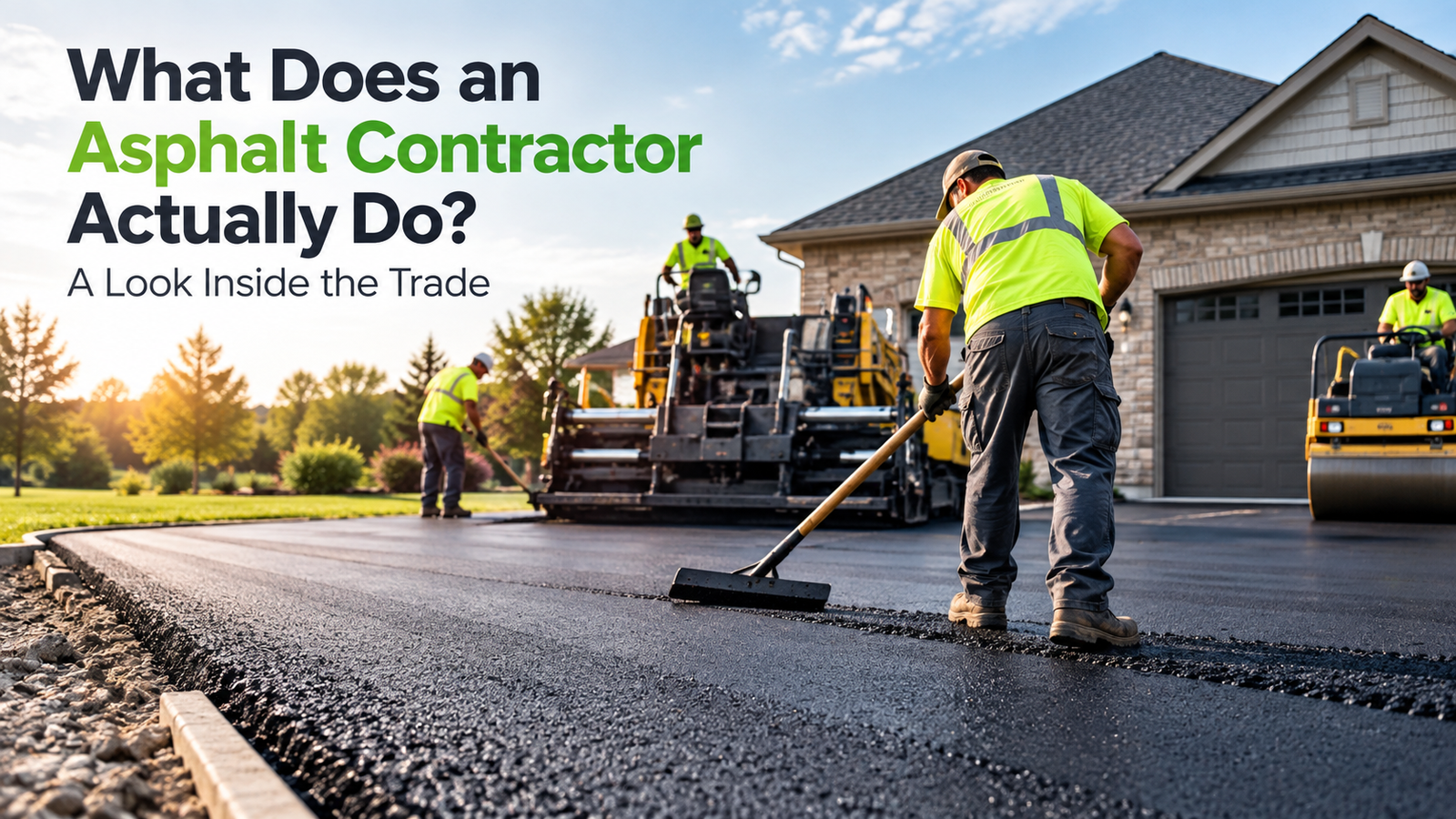
The term “Asphalt Contractor Midland” gets used loosely, sometimes applied to anyone with a truck and a bag of patching compound. In reality, asphalt paving is a specialized trade that combines earthwork, materials science, heavy equipment operation, and a working knowledge of drainage and grading. For property owners in Midland and the surrounding Cabarrus County area trying to understand what separates a properly executed paving job from one that fails within a few years, it helps to look at what the work actually involves from start to finish.
The Scope of Work Beyond “Laying Asphalt”
Most people picture asphalt paving as a paver truck spreading hot material across a surface, but that step is really the final stage of a much longer process. A typical project involves site assessment, grading, drainage planning, base construction, and often coordination with other trades or utility markers before any asphalt is placed.
An asphalt contractor’s day-to-day scope generally includes:
- Evaluating existing subgrade conditions and soil type
- Designing or following a grading plan that directs water away from structures
- Operating or overseeing equipment for excavation, grading, and compaction
- Selecting the correct asphalt mix design for the application, whether residential driveway, commercial lot, or roadway
- Managing the timing of installation around weather and temperature
- Performing quality control checks on compaction and thickness
- Finishing details like edges, joints, and transitions to existing structures like garages or sidewalks
Each of these steps requires different equipment and expertise, which is part of why asphalt paving businesses typically maintain a range of machinery, from skid steers and excavators to rollers and paving machines.
Equipment Involved in a Typical Paving Project
Understanding the equipment involved helps explain why paving projects follow the sequence they do.
Excavators and skid steers handle the removal of old material, whether that’s soil, gravel, or deteriorated asphalt, and rough grading of the site.
Graders fine-tune the slope and surface of the base layer to ensure proper drainage before any asphalt goes down.
Compactors and rollers come in several forms, including vibratory plate compactors for smaller areas and steel-drum rollers for larger surfaces. Compaction density is one of the most important, and most overlooked, factors in how long a paved surface lasts.
Asphalt pavers spread hot mix asphalt evenly at a controlled thickness, a task that’s difficult to replicate accurately with hand tools alone, which is why DIY asphalt work rarely performs as well as machine-laid material.
Milling machines grind up existing asphalt, either to prepare a surface for an overlay or to remove and recycle old pavement material entirely.
How Asphalt Mix Design Varies by Application
Not all asphalt is the same. Mix designs vary based on aggregate size, binder content, and intended use, and an experienced contractor selects the right one for the job rather than applying a one-size-fits-all approach.
A residential driveway typically uses a finer surface mix because it prioritizes a smooth appearance and doesn’t need to withstand heavy commercial traffic. Commercial parking lots and roadways generally call for a coarser, more durable mix, sometimes with a thicker binder course underneath, since they need to handle heavier and more frequent vehicle loads, including delivery trucks or waste collection vehicles that place concentrated stress on pavement during turning.
Climate also factors into mix selection. In a region like the Piedmont that experiences hot summers and occasional freeze-thaw cycles in winter, a mix with the right binder characteristics helps the pavement flex slightly rather than crack under thermal stress.
Grading and Drainage: Where Experience Shows
Grading is one of the most technical aspects of paving work, and it’s also one of the hardest for property owners to evaluate just by looking at a finished driveway or lot. Proper grading typically establishes a slope of roughly 1 to 2 percent, enough to move water off the surface without being so steep that it feels uneven underfoot or causes vehicles to feel unstable.
Complications arise on sites with unusual topography, existing structures nearby, or clay-heavy soil that doesn’t drain well on its own. In these situations, additional measures like French drains, catch basins, or subsurface drainage pipe may be incorporated into the design. An asphalt contractor who understands these principles will often flag drainage concerns during the site evaluation phase, well before any paving begins, since it’s far easier to correct grading issues at that stage than after asphalt has already been installed.
Licensing, Insurance, and Industry Standards
Asphalt paving, like most construction trades, typically involves state or local licensing requirements, particularly for larger commercial projects, and contractors generally carry liability insurance to cover potential property damage or worksite incidents. Beyond licensing, many paving companies also follow industry standards published by organizations like the National Asphalt Pavement Association (NAPA), which outlines best practices for mix design, compaction testing, and quality control across the industry.
These standards exist because asphalt performance is measurable. Compaction density, for example, can be tested with core samples or nuclear density gauges, giving an objective way to verify that a surface was properly installed rather than relying solely on visual inspection.
The Role of Weather and Temperature
Temperature affects nearly every stage of asphalt work. Asphalt needs to be manufactured at a hot-mix plant, transported while still hot, and placed and compacted before it cools below the point where it can be properly densified. In general, most paving contractors avoid laying asphalt when ambient temperatures fall much below 50 degrees Fahrenheit, since cooler conditions cause the material to lose workable heat too quickly for proper compaction.
This is why paving season in the Piedmont typically runs from spring through early fall. Rain is another factor: asphalt cannot be placed on a wet base, since trapped moisture interferes with proper bonding and compaction, so contractors monitor forecasts closely when scheduling work.
How Quality Control Works on a Paving Job
Quality control on a paving project generally happens at several checkpoints rather than just at the end.
During base preparation, compaction is checked to confirm the subgrade can support the loads it will bear. During paving itself, mat temperature is monitored to ensure the asphalt is still within the correct range for proper compaction when the rollers pass over it. After compaction, thickness is checked, often with a straightedge or measuring probe, to confirm the surface meets design specifications. Finally, a visual inspection checks for consistent texture, proper joint sealing, and correct slope across the finished surface.
This layered approach to quality control is part of why asphalt paving, despite looking straightforward from the outside, benefits from experienced oversight at each stage rather than a single final inspection.
Common Misconceptions About Asphalt Work
A few misunderstandings come up repeatedly among property owners:
“Thicker asphalt is always better.” Thickness matters, but only in combination with proper base preparation. A thick layer of asphalt over a poorly compacted or inadequately drained base will still fail, sometimes faster than a thinner layer over a well-built foundation.
“All asphalt mixes are interchangeable.” As covered earlier, mix design varies significantly based on intended use, traffic load, and climate, and using the wrong mix for the application can shorten the lifespan of a surface considerably.
“Sealcoating fixes cracks.” Sealcoating is a protective, preventive maintenance step. It doesn’t have the strength or depth to repair structural cracking, which requires actual crack sealing or, in more serious cases, patching or replacement.
“New asphalt should be perfectly black forever.” As discussed in other resources on asphalt maintenance, fading to gray over time is a normal part of oxidation and doesn’t necessarily indicate a problem with the pavement’s structural integrity.
How Site Access and Logistics Affect a Project
Beyond the technical work of grading and paving, an asphalt contractor also has to manage the logistics of getting heavy equipment and hot material to and from a site efficiently. This becomes especially relevant on properties with limited access, tight turning radii, or nearby structures that leave little room for large machinery to maneuver.
Paver trucks, roller equipment, and material delivery trucks all need adequate space to operate safely, and a contractor experienced in navigating tighter residential lots or established commercial sites with existing landscaping typically plans equipment staging and delivery timing carefully to avoid delays or damage to surrounding areas. On larger commercial projects, this logistical planning can also involve coordinating around active business operations, ensuring that customer or employee access isn’t unnecessarily disrupted during the paving process.
The Difference Between Hot-Mix and Cold-Mix Asphalt
Most permanent paving work uses hot-mix asphalt, produced at a plant and kept heated during transport and installation to allow for proper compaction. Cold-mix asphalt, by contrast, is a pre-mixed product that doesn’t require heating and can be applied at ambient temperatures, making it useful for temporary patches or repairs made outside the typical paving season.
While cold-mix asphalt has its place, particularly for quick pothole patches during colder months when hot-mix isn’t readily available, it generally doesn’t achieve the same density or long-term durability as properly installed hot-mix asphalt. An experienced asphalt contractor typically reserves cold-mix applications for temporary or emergency situations rather than permanent installations, reflecting an understanding of which materials suit which circumstances.
How Contractors Approach Existing Pavement Repairs
Not every project involves a completely new surface. Asphalt contractors frequently handle repair work on existing pavement, which requires a somewhat different diagnostic approach than new installation. Before any repair begins, an experienced contractor typically evaluates whether the damage is isolated to the surface layer or extends into the base, since surface-level cracking can often be addressed with crack sealing or a patch, while base failure usually requires more extensive excavation and reconstruction of that specific area.
This diagnostic step matters because a surface-level fix applied to an area with underlying base failure will typically fail again within a short period, whereas correctly identifying and addressing the root cause, even if it requires more invasive work upfront, tends to produce a more durable, longer-lasting repair.
How Experience Shows Up in the Small Details
Some of the clearest signs of an experienced asphalt contractor show up in details that are easy to overlook until something goes wrong. Clean, straight edges along a driveway’s perimeter, smooth transitions where new asphalt meets an existing garage apron or sidewalk, and consistent surface texture across the entire paved area all reflect careful attention during the finishing stages of a project, rather than simply rushing to complete the visible surface work.
Joint work between separate paving passes is another detail that matters more than it might initially seem. When asphalt is laid in sections, whether due to the size of the area or equipment limitations, the seams between those sections need to be compacted with particular care, since these joints are naturally weaker points where water can penetrate more easily if not properly sealed and compacted during installation. An experienced crew typically pays close attention to these transitions, understanding that a project’s long-term durability often depends as much on how well these smaller details are executed as on the overall mix design and base preparation.
Frequently Asked Questions
How is asphalt paving different from concrete work?
Asphalt is a flexible pavement material that can shift slightly with temperature changes, while concrete is rigid and relies on control joints to manage cracking. The two require different equipment, mix designs, and installation timelines, which is why they’re generally treated as distinct specialties within the paving trade.
What is the ideal temperature range for laying asphalt?
Most contractors aim to place asphalt when ambient air temperatures are above roughly 50 degrees Fahrenheit and rising, since colder conditions cause the mix to cool too quickly for proper compaction.
Why does compaction matter so much?
Compaction determines the density of the finished pavement. Under-compacted asphalt has more air voids, which allow water and air to penetrate the surface more easily, accelerating oxidation and cracking over time.
Can asphalt be paved over an existing driveway?
In many cases, yes, through a process called an overlay, provided the existing base and surface are structurally sound. If the base has failed or there’s significant cracking throughout, a full removal and replacement typically performs better long-term than paving over compromised material.
What causes asphalt to crack in patterns rather than randomly?
Patterned cracking, like alligator cracking, usually points to a structural issue in the base layer, while random, isolated cracks are more often related to surface aging or minor settling.
Understanding what goes into professional asphalt work makes it easier to recognize a properly executed project and to ask informed questions about grading, drainage, and materials. Learn more about asphalt paving standards and services at https://www.victorypavingnc.com/midland/asphalt-contractor/.